After 50 Years, Western North Carolina Just Took a Major Step Toward Getting Our Trains Back

After 50 years without passenger rail service, Western North Carolina just took a major step toward getting our trains back. NCDOT's new 30-year rail plan, published just lack week, officially recognizes what we've been saying all along: the Asheville-Salisbury line is vital to our region’s future.
But here's the catch: you have until January 20, 2026 to tell state officials why this matters.
Remember when 632 people in Drexel—a town of just 1,800—signed our petition? Remember when Speaker Tim Moore came to Drinks at the Depot and acknowledged that rail is "less expensive" than building roads? That grassroots energy is why the Asheville-Salisbury line made it into this plan.
Now we need to finish what we started.
What Is the Comprehensive State Rail Plan?
NCDOT's draft Comprehensive State Rail Plan is North Carolina's blueprint for passenger and freight rail over the next 30 years. This document determines where the state's rail dollars go for the next three decades.
The plan identifies over 550 projects statewide, with more than 160 scheduled for completion in the next five years—ranging from safety improvements at railroad crossings to entirely new passenger rail routes.
For us in Burke, McDowell, Buncombe, Catawba, Iredell, Rowan, and surrounding counties, this represents official state recognition that Western North Carolina deserves passenger rail service.
The Asheville-Salisbury Line: Officially Selected for Federal Support
Here's the headline: the Asheville-Salisbury corridor is one of seven routes selected for the federal Corridor Identification and Development (CID) Program.
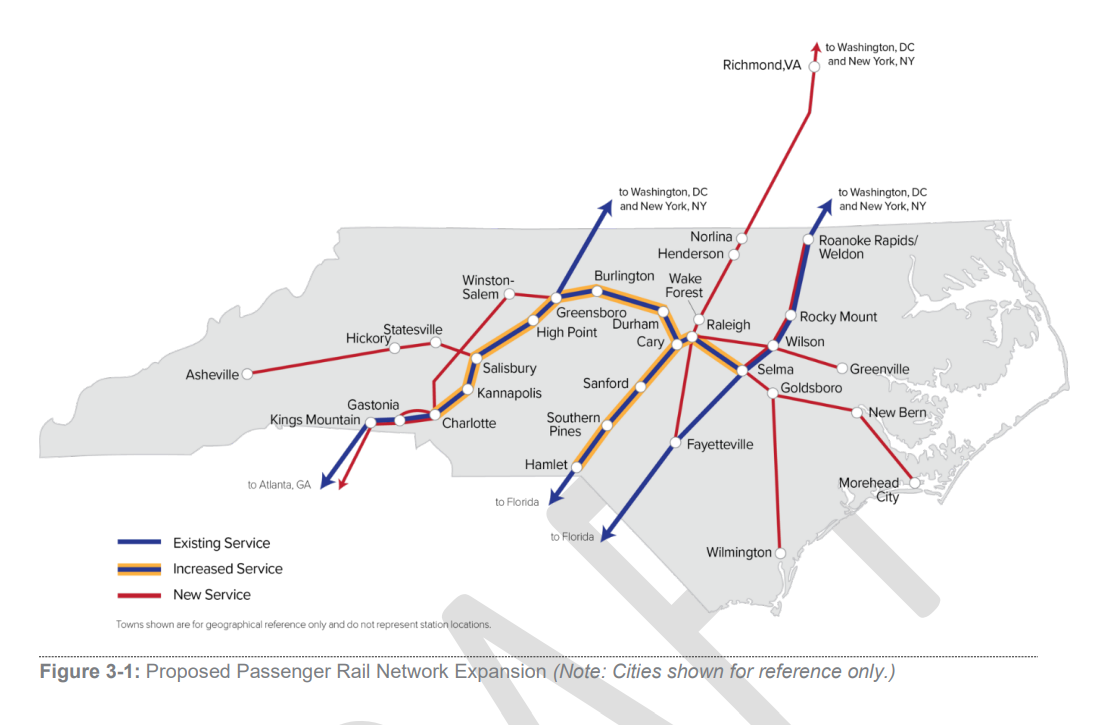
CID Program Routes (Courtesy of NCDOT)
Understanding the CID Program
Created under the 2021 Bipartisan Infrastructure Law, the CID Program moves corridors from concept to construction-ready through three phases:
Phase 1 (Scoping): Define corridor needs - $500,000 federal grant, no state match required
Phase 2 (Service Development Planning): Create detailed project lists - requires 10% state/local match
Phase 3 (Preliminary Engineering): Get projects "shovel-ready" - requires 20% state/local match
After completing these three CID phases, projects compete for construction funding through programs like the Federal-State Partnership for Intercity Passenger Rail—the same program that gave North Carolina $1.09 billion in 2023 for the Raleigh to Wake Forest segment.
In 2023, NCDOT submitted applications for 12 corridors. Only seven were selected.
The Asheville-Salisbury corridor was one of those seven.
What This Means for Western North Carolina
This 139-mile route would follow the Norfolk Southern AS-Line, reconnecting Hickory, Morganton, Marion, Old Fort, and Asheville to the rest of the state after half a century of isolation. At Salisbury, riders would transfer to existing Piedmont and Carolinian services, accessing Charlotte, Raleigh, and destinations up and down the East Coast.
For the first time since 1975, you could board a train in Asheville and arrive in Raleigh without fighting I-40 traffic.
Work has already begun. Scoping studies for all seven selected corridors started in spring 2024, with Phase 1 wrapping up by the end of 2025. Phase 2 service development plans typically take another two to three years.
By the Numbers:
1390 miles between Asheville and Salisbury
100,000 projected local trips annually
150,000 to 290,000 connecting trips via Charlotte-Raleigh service
80,000 to 160,000 connecting trips via Raleigh-DC corridor
$500,000 in federal planning funds already secured
What the Plan Says About Our Region
The State Rail Plan acknowledges that Western North Carolina has been underserved for far too long. It specifically mentions the Western North Carolina Rail Committee's three goals: improve freight rail service, increase tourist trains, and re-establish passenger rail connections.
The plan discusses our region in terms of population growth, economic opportunities, environmental benefits, and—critically after Hurricane Helene—transportation resilience when highway systems fail.
The Funding Reality (And Why Your Voice Matters)
Here's the truth: most projects in this plan don't have funding yet.
Over the next 30 years, North Carolina has identified $12.2 billion in "Next Steps" projects and $16.5 billion in "Vision" projects. The vast majority lack dedicated funding sources.
Additionally, under current state law, passenger rail projects cannot compete for funding at the statewide level—they're only eligible for regional or local dollars, and total funding for all non-highway transportation is capped at 10 percent. For commuter and light rail, state law caps the state contribution at 10 percent of the regional allocation or total project cost, which effectively keeps most state transportation dollars flowing to highways.
This is exactly why sustained public advocacy matters.
Since 2018, NCDOT has secured over $1.3 billion in federal grants for rail projects. Federal funding requires state matching funds, but it dramatically extends what North Carolina can accomplish.
The more clearly officials understand public support for the Asheville-Salisbury line, the better positioned they'll be to secure both state matching funds and federal competitive grants.
We need to apply positive pressure—constant, consistent, and clear—to ensure the Asheville-Salisbury line becomes reality.
What Makes This Different from Past Promises
Being selected as one of seven corridors out of twelve applications signals real momentum. This isn't a feasibility study that will sit on a shelf. Consultants are actively working. Stakeholder engagement is underway.
The plan also reflects changed realities: climate concerns, demographic shifts (Gen Z views car ownership differently), unprecedented federal infrastructure funding, and post-Helene awareness of transportation system fragility.
All of these factors create conditions more favorable to passenger rail than existed even five years ago.
Don't Want to Read 200+ Pages? Start Here
Focus your reading on:
Executive Summary (pages 1-6) - The big picture
Chapter 3, Section 3.2.1 (page 3-5) - Asheville-Salisbury corridor details
The CID Program handout - How federal funding works
The project map - All proposed routes visually
Available at publicinput.com/nc-staterailplan
Make Your Voice Heard: You Have 21 Days
NCDOT is accepting public comments through January 20, 2026.
That's 21 days from now. Set a reminder. It takes five minutes and could determine whether Western North Carolina gets passenger rail in 2032 or 2042—or at all.
Submit feedback at: publicinput.com/nc-staterailplan
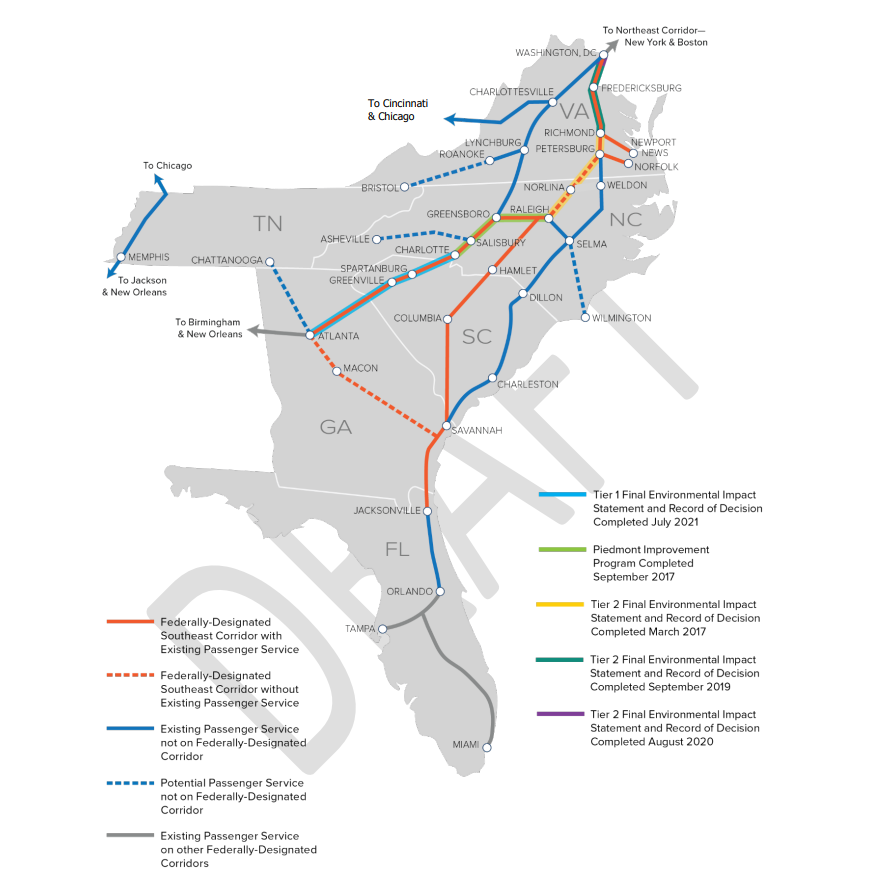
Overview of Southeast Corridor (Courtesy of NCDOT)
What Should You Say?
Don't just copy these—add your own reasons. Tell NCDOT what passenger rail would mean for your life, business, family, or community.
Example #1: Personal Experience
"I support the Asheville-Salisbury line. As someone who studied abroad in Europe, I experienced how reliable train service connects even small towns to major cities. Morganton deserves the same infrastructure. Please prioritize funding for this corridor."
Example #2: Economic Development
"The Asheville-Salisbury line represents significant economic opportunity for Burke, McDowell, and surrounding counties. Tourism, business access, and jobs will increase when we're connected to North Carolina's passenger rail network. Make this corridor a top funding priority."
Example #3: Environmental & Practical
"I'm thrilled to see the Asheville-Salisbury line in the CID Program. Passenger rail offers an environmentally sustainable alternative to driving and provides crucial transportation access for residents who don't own cars or can't drive. Move this project forward quickly."
Example #4: Post-Helene Resilience
"Hurricane Helene showed how quickly our highway system can become unusable. Passenger rail provides transportation redundancy that makes our region resilient. The Asheville-Salisbury line isn't just about convenience—it's about ensuring Western North Carolinians can reach jobs, healthcare, and family regardless of what challenges we face."
Example #5: Thank and Push Forward
"Thank you for including the Asheville-Salisbury corridor in the CID Program. I've followed Waiting for the Train's progress and am thrilled to see our advocacy paying off. Now take the next step: prioritize state matching funds so we can move from planning to construction quickly."
You can also thank NCDOT, highlight specific community needs, reference strong local support, mention funding barriers, and emphasize post-Helene transportation lessons.
What Happens Next
After January 20, 2026, NCDOT will review feedback and update the plan. NCDOT expects the North Carolina Board of Transportation to adopt the plan in February 2026, after which the department will submit it to the Federal Railroad Administration for final acceptance.
Once approved, this becomes North Carolina's official rail roadmap for 30 years—guiding funding decisions, grant applications, and infrastructure investments.
We have one chance to make our voices heard before this plan is finalized.
The Next Five to Seven Years
When we started Waiting for the Train, we talked about five to seven years. That timeline still holds—but only if we maintain pressure.
The Asheville-Salisbury corridor is in the planning phase, moving through the CID Program toward becoming "shovel-ready" for major construction grants.
Getting from planning to construction requires continued advocacy: public comments before January 20, conversations with state representatives, and showing up to prove how vital passenger rail is to our region’s future.
This Is Our Moment
For 50 years, Western North Carolina has been left off the map. We've watched other corridors get funding. We've heard promises.
This is different. Our corridor has federal CID funding. Consultants are working. The timeline is real.
But plans gather dust without public pressure. The Asheville-Salisbury line will only become reality if state officials know—without question—that Western North Carolinians are ready for this train.
You have until January 20 to make your voice heard. Don't wait. Don't assume someone else will do it.
Visit publicinput.com/nc-staterailplan today. Tell them why the Asheville-Salisbury line matters. Tell them Western North Carolina is done waiting.
P.S. Forward this to anyone in Burke, McDowell, Buncombe, Catawba, Iredell, Rowan, or surrounding counties who cares about bringing passenger rail back to Western NC. The more voices NCDOT hears before January 20, the stronger our case becomes.
Waiting for the Train is a grassroots coalition working to restore passenger rail service to Western North Carolina.